BOAT TRANSPORT ·
Can You Ship a Boat Without a Trailer? A Marina-to-Marina Planning Guide
By Genius Auto Trans · 8 minute read
The short answer: A boat without its own road trailer can be transported when the hull’s actual dimensions, weight, support method, loading equipment and access at both ends are confirmed before dispatch. The move usually requires a compatible carrier trailer or a fitted cradle, plus separate marina arrangements for haul-out and launch. “No trailer” is a planning condition—not an automatic barrier.
The most common failure is not the highway portion. It is reaching pickup day without a confirmed lift appointment, support plan or usable loaded-height estimate. Treat the move as three connected jobs: remove the boat from its current support, carry it safely over the road, and transfer it to the destination’s support or water.
Start with support—not with a pickup date
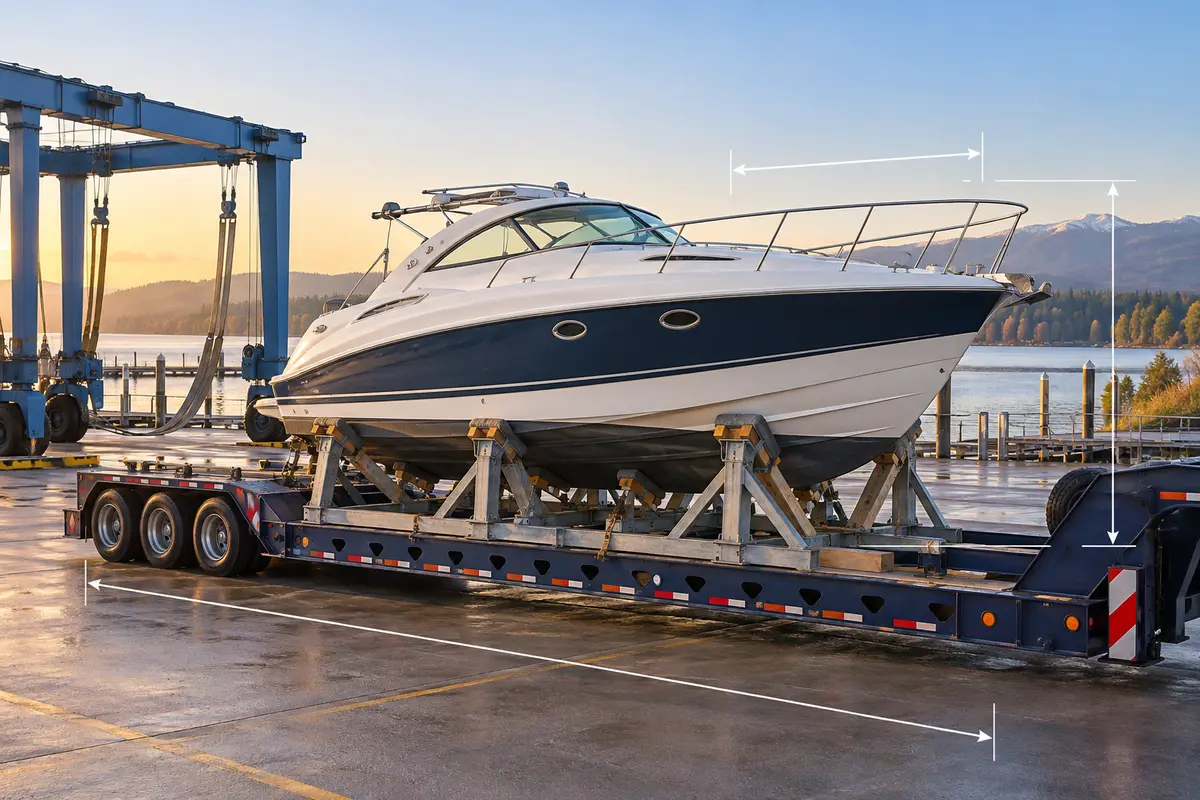
A boat normally rests on bunks, rollers or a cradle shaped and positioned for its hull. When the owner’s road trailer is unavailable, the transport plan must provide that support another way. Possible arrangements include a boat-specific carrier trailer, a fitted cradle on a flatbed or step-deck, or a low-deck configuration for a taller vessel.
The correct setup depends on more than length. A deep-V hull, stepped hull, keel, shaft, propeller, rudder, outdrive or unusual chine changes where the boat may be supported and how much clearance it needs. Send current photos of the hull from both sides, stern, bow and underside when visible. Identify existing damage, repairs and areas the manufacturer or yard says must not bear weight.
Do not improvise blocks or specify sling and support points from a generic checklist. Ask the marina or manufacturer for vessel-specific guidance, then share it with the transport coordinator. The assigned transport provider is responsible for using equipment suited to the actual load and complying with cargo-securement requirements.
FMCSA explains that commercial cargo must be contained, immobilized or secured so it does not shift enough to affect vehicle stability or fall from the vehicle. Its cargo securement overview describes the federal framework. That does not replace a hull-specific support plan; it explains why the complete boat, cradle and trailer combination must be evaluated together.
Measure what will travel—not just the model
Manufacturer specifications are useful, but options, engines, rails and aftermarket equipment can change the real dimensions. A useful quote request separates the boat’s own dimensions from the completed transport profile.
- Overall length: include pulpits, swim platforms, outboards and any fixed projection that remains attached.
- Beam: measure the widest permanent point of the hull or attached structure.
- Boat height: measure from the lowest hull or keel point to the highest item that will remain installed.
- Loaded height estimate: combine the boat, support and proposed trailer deck height. This—not the boat’s standalone height—is what affects route clearance.
- Weight: distinguish published dry weight from the estimated transport weight after engines, batteries, fuel, water, gear and cradle are considered.
List anything that can be professionally lowered or removed: mast, radar arch, hardtop, tower, antennas, outriggers, canvas, windscreen or outdrive. Removal can change the loaded profile, but every component needs a documented reinstall plan and safe storage. Do not remove structural or navigation equipment simply to chase a smaller measurement without the yard or manufacturer’s guidance.
Include year, make, model and the Hull Identification Number in the release paperwork. The U.S. Coast Guard notes that a boat’s HIN uniquely identifies the vessel and that even one incorrect character changes the identity represented. Its HIN guidance explains verification methods. Match the number on the hull, title or registration and marina release documents before pickup.
Review Genius Auto Trans’s boat transport service, then send the measurements, photos, ZIP codes, earliest release date and requested delivery window for a shipment-specific evaluation. Do not use an online car calculator as a substitute for the boat’s loaded profile.
Book two handoffs before the highway move
Road transport does not automatically include hauling a boat out of the water, operating a travel lift, supplying a crane, blocking the hull in a yard or launching it at destination. Those are marina or yard services unless the written agreement explicitly says otherwise.
Ask the origin facility:
- Will the boat be out of the water and ready before the carrier arrives?
- What is the travel-lift, forklift or crane capacity, and can it reach the proposed trailer?
- Does the yard supply slings, spreader bars, blocking or a transport-rated cradle?
- What are the appointment window, entrance, gate procedure and cancellation rules?
- Who can authorize release, identify the HIN and sign the pickup condition report?
Ask the destination the same questions in reverse. A marina that can haul a boat from water may not be able to lift it from a lowboy or step-deck. Share the transport equipment type and expected loaded configuration before reserving the lift. Confirm a wide, stable work area and enough overhead and side clearance for both the carrier and marina equipment.
Create one written handoff sheet with the marina names, street addresses, yard contacts, mobile numbers, appointment windows and after-hours limits. If the carrier’s estimated arrival moves, the active contact—not an unattended office line—must be able to coordinate the revised handoff.
If an address has a narrow entrance, soft surface, low trees, seasonal gate or restricted commercial access, identify it before equipment is assigned. Our door-to-door access guide explains why pickup and delivery mean the closest safe, legal and workable point—not a promise that every trailer can reach every dock.
Let the complete dimensions drive route planning
State limits and permit processes vary. A boat that moves routinely in one loaded configuration may need a different route, schedule or permit when its beam, overall height, length or weight changes. Avoid declaring the boat “standard” or “oversize” yourself; provide accurate facts and let the transport provider evaluate the complete load.
The Federal Highway Administration’s current oversize and overweight permit directory directs carriers to the permitting websites for the states in which they will travel. It is a useful reminder that interstate planning is not governed by one universal threshold or one national permit.
Route review may need to account for bridge and tunnel clearances, construction, seasonal restrictions, local roads, marina entrances and time-of-day rules. A straight line or consumer navigation app does not prove that a permitted load can legally or safely use a road. Do not make nonrefundable lift or travel arrangements until the transport plan and timing assumptions are aligned.
Genius Auto Trans offers road transport within the 48 contiguous states and Washington, DC. It does not provide Alaska, Hawaii, international, container, RoRo or on-water delivery. If the boat is not suitable for road transport in the proposed configuration, another type of marine logistics service may be required.
Prepare the vessel for wind, vibration and inspection
Highway airflow is different from marina storage. Remove or secure loose cushions, electronics, lines, fenders, covers and personal gear. Close and latch hatches, windows, lockers and cabin doors. A cover should remain only when its manufacturer and the transport provider approve it for highway use; a loose cover can flap, tear or damage the finish.
Have the yard lower or remove antennas, towers, outriggers, canvas frames and other equipment included in the approved transport configuration. Label hardware and photograph each assembly before removal. Never ask the driver to perform specialized marine disassembly unless that service is expressly included and qualified personnel are available.
Follow the boat manufacturer and marina’s written instructions for batteries, fuel, water, sanitation systems, engines and winterization. Do not apply a generic “drain everything” rule: the safe procedure depends on the vessel, system, season and facility. Tell the transport coordinator about remaining liquids, leaks or hazardous conditions before pickup.
Photograph the hull, rub rail, transom, bow, deck, propellers, drives, rudder, windows and interior before loading. Add close photographs of existing cracks, chips, corrosion or repairs. Review the written condition report at pickup and again before signing at delivery.
Before dispatch, request the assigned transport provider’s applicable insurance certificate and read the limits, exclusions and valuation terms against the actual boat, cradle and accessories. Do not treat a general statement or this article as proof that every loss or item is covered.
Three boat-without-trailer planning examples
These are practical scenarios, not customer stories, prices, schedules or guarantees.
A cabin cruiser from Michigan to Tennessee
The boat is stored on yard blocks in Michigan and has no road trailer. The owner supplies beam, hull height, dry weight, current photos and a list of fixed rails. The origin yard confirms a travel-lift slot and sling plan. A storage yard in Tennessee confirms it can lift from the proposed low-deck trailer and provide destination blocking.
A center-console from Florida to Ohio
The seller’s marina in Florida holds the boat in dry storage. The buyer verifies the HIN, authorizes release and asks the marina to measure the boat with the hardtop, outboards and bow pulpit included. The receiving dealer in Ohio provides commercial access and a forklift appointment suited to the boat’s weight and lift points. The transport request identifies both facility contacts rather than only the buyer and seller.
A sailboat from Washington to Arizona
A qualified yard in Washington removes and secures the mast, boom and rigging, then measures the hull’s loaded profile in its fitted cradle. The destination yard in Arizona receives the mast separately on the same approved setup and confirms lift access. Route evaluation uses the completed loaded height—not the sailboat’s brochure dimensions.
Boat transport without a trailer: FAQs
Can a boat be transported if it does not have a road trailer?
Yes, when suitable transport equipment, hull support and loading arrangements are available for the boat’s dimensions and route. The boat may travel in a fitted cradle on a flatbed, step-deck or low-deck trailer, or on another boat-specific setup. The equipment must be confirmed before pickup.
Does road transport include lifting the boat out of the water?
Do not assume it does. Marina haul-out, travel-lift, crane, forklift, blocking and launch services are separate site arrangements unless written terms say otherwise. Confirm who performs each lift, what equipment they require and when the appointment is booked.
Which measurements are needed for a boat transport quote?
Provide overall length, beam, approximate weight and the estimated loaded height on the proposed support and trailer. Also identify removable towers, antennas, pulpits, outriggers, radar equipment, outdrives and masts. Current photos and manufacturer specifications help, but actual measurements control the plan.
Will my boat need oversize permits?
That depends on the complete loaded dimensions, weight and states on the route. Thresholds and permit requirements vary by jurisdiction. The transport provider must evaluate the actual combination and obtain any required permits; an owner should not assume a boat is routine based only on hull length.
Can Genius Auto Trans ship my boat to Alaska, Hawaii or another country?
No. Genius Auto Trans offers road transport within the 48 contiguous states and Washington, DC. It does not provide Alaska, Hawaii, international, container, RoRo or on-water captain services.
Request a boat transport plan built around the actual hull
Tell Genius Auto Trans the route, year, make, model, HIN, length, beam, estimated transport weight, boat height, removable equipment, cradle situation and lift access at both ends. Include current photos and both marina contacts so equipment and route requirements can be evaluated before assignment.
Request my boat transport quote →