
PICKUP & DELIVERY ·
Door-to-Door Auto Transport: What If the Truck Cannot Reach Your Home?
The short answer: Door-to-door auto transport brings your vehicle as close to your pickup and delivery addresses as the carrier can safely and legally reach. If a large truck cannot access the property, you and the driver coordinate a suitable nearby meeting point. Set that plan before the handoff, not after the truck arrives.
For an interstate move, the last mile can need more planning than the long highway journey. A driveway that works for a moving van may not work for a loaded car hauler. The useful question is not just “Do you serve my ZIP code?” It is “How will we complete the handoff at each end?”
Start with the address, not just the ZIP code
Give your coordinator the full pickup and delivery addresses and explain any known access restrictions. A quote based on two cities does not tell the driver whether a gate, private road or tight corner will block the final approach.
Check both ends of the move for these details:
- Entry: gates, guard stations, overhead structures, low branches or limited delivery hours.
- Approach: narrow streets, sharp turns, parked vehicles, construction or posted truck restrictions.
- Loading space: room to position the truck, use its equipment and inspect the car without obstructing traffic or emergency access.
- Exit: a workable way for the truck to leave, not simply enough room to enter.
The FMCSA’s passenger-driver safety guidance explains that large trucks need extra room for turns and have significant blind spots. That is why the carrier must assess the actual approach; a passenger-car navigation route is not an access approval.
A photo of an entrance or a map pin can help explain the issue. Neither replaces the driver’s assessment of the truck, current conditions and permitted access.
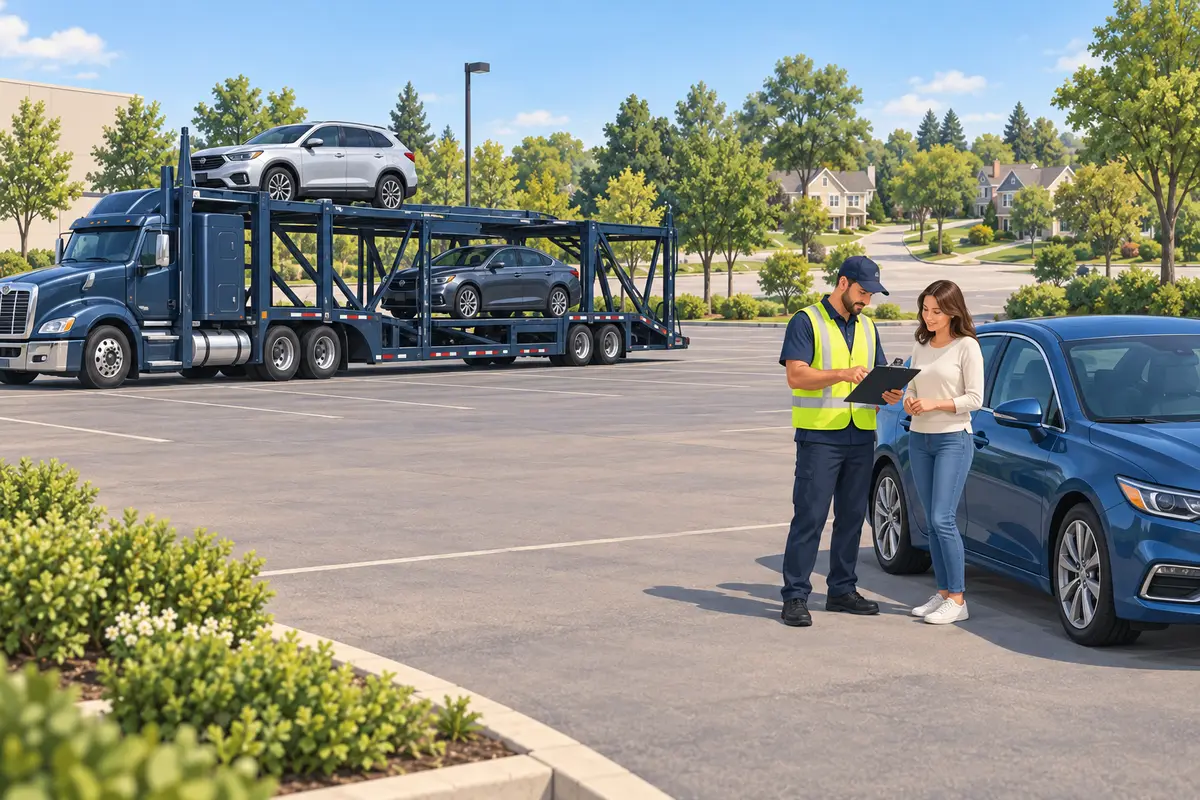
Agree on a nearby location that actually works
Suggest a location near your address, then have the driver and coordinator confirm it. A spacious commercial lot with permission may be an option. A busy curb, highway shoulder or area blocking an entrance is not a sensible default.
Before agreeing, confirm four things: permission to use the area, a truck-accessible entrance and exit, enough space for the specific equipment, and a safe place for you to wait while the driver works. A lot can be empty when you visit and crowded at the planned handoff time.
Record the exact meeting pin and entrance, not only the business name. Large properties can have separate customer and commercial entrances. Also decide how you will get home after pickup or reach the delivery point before unloading.
If moving the car to that point is difficult, say so early. An inoperable car, a customer without a second driver or a vehicle with very low clearance may require a different arrangement. Ask whether extra equipment or local movement is available and request written pricing before accepting it.
Three nationwide planning examples
These are illustrative situations, not customer stories or promises about a particular property.
An apartment move from Texas to California
You can leave your car at the Texas apartment until Friday, but your flight is Thursday. At the California end, your new building has an underground garage. Flag both issues when discussing your Texas-to-California shipment: an authorized adult may need to handle pickup, while delivery needs an accessible above-ground meeting point. Do not build the plan around the truck arriving just before your flight.
A city address in Illinois
For an Illinois vehicle move, imagine a building with a narrow rear alley and no suitable space out front. Give the coordinator that information before dispatch. Ask about a permitted nearby handoff location and tell your representative which entrance to use. A building’s package-delivery area should not be assumed suitable for a car transporter.
A seasonal stay in a gated community
A community in Florida or Arizona may have its own visitor and commercial-delivery procedures. Ask property management about the actual rules rather than assuming that a gate code is enough. If the driver cannot enter, arrange an approved meeting place outside the community and confirm who can receive the car if your travel plans change.
Separate the pickup window from your personal deadline
Your first available pickup date is the earliest the vehicle is ready. A pickup window is the estimated period when collection can happen. Transit starts after collection; it is not the same as the total time from requesting a quote to receiving the car.
Tell the coordinator about a lease ending, flight, work start date or property closure. Ask what happens if the truck’s estimate changes. Genius Auto Trans provides planning windows rather than guaranteed arrival hours, so keep a workable alternative for any deadline you cannot move.
Choose an adult backup contact who can attend in person and reach you. Confirm any authorization requirements, key handoff, inspection responsibilities and payment instructions through your established coordinator. Do not leave the vehicle unattended with an informal note and assume that collection can proceed.
Keep enough time for the actual handoff
A meeting point is not just a place to pass over keys. Allow time to identify the assigned driver, review the car’s condition and complete the transport documents. Stay clear of loading equipment and let the driver direct safe positioning.
At delivery, your representative needs the pickup condition record and instructions for documenting any new damage before signing. For the vehicle itself, use our separate car preparation checklist. This guide’s job is to make sure the right people and vehicle reach a workable location.
Frequently asked questions
Does door-to-door mean the carrier must enter my driveway?
No. It means pickup and delivery near your chosen addresses, subject to safe and permitted truck access. If the address is unsuitable, agree on a nearby alternative with the driver and coordinator.
Can I choose a shopping-center parking lot?
You can suggest one, but an empty-looking lot is not automatically an approved loading area. Confirm property permission, truck access and available space with the coordinator and driver before making it the meeting point.
What if I cannot drive the car to the meeting point?
Explain this before booking. If the vehicle is inoperable, disclose whether it rolls, steers and brakes. Ask which loading or local-movement arrangements are possible and what they cost; do not assume towing or a smaller shuttle vehicle is included.
Can someone else receive my vehicle?
Arrange an adult representative with your coordinator in advance. Give them the carrier contact, agreed location and time window, vehicle-condition records and instructions for reviewing and signing the delivery documents.
Is an expedited shipment guaranteed to arrive at a specific hour?
No. Genius Auto Trans describes expedited service as a tighter pickup window, still subject to carrier availability. Ask for the applicable pickup and transit estimates and build a backup plan around any fixed deadline.
Plan the route and the last mile together
Genius Auto Trans arranges vehicle transport across the 48 contiguous states and Washington, DC. Review our transport services and include access details with your quote request so pickup and delivery can be discussed before dispatch.
Get my auto transport quote →Service details checked September 20, 2026 against the Genius Auto Trans services page and FAQ. Actual access and shipment arrangements must be confirmed for your addresses.